
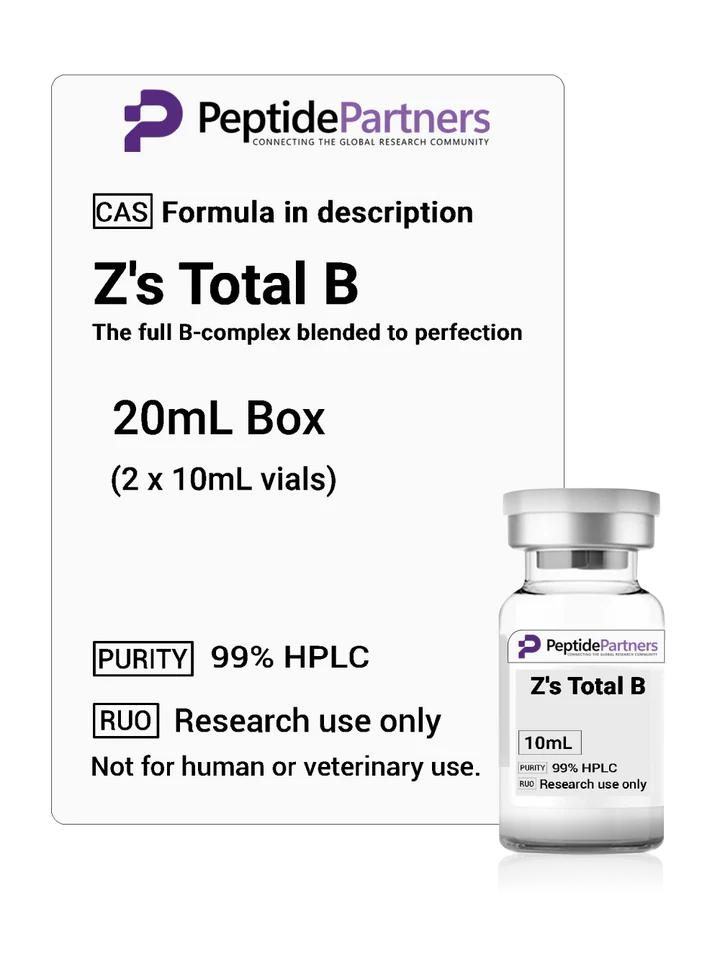
Z’s Total B Kit (10mL vials)
Price range: $165.00 through $330.00
• Format: Multi-component liquid blend (9 B-vitamins + excipients)
• Key Components: B1 (Thiamine HCL), B2 (Riboflavin-5-Phosphate), B3 (Niacin + Nicotinamide), B5 (Dexpanthenol), B6 (Pyridoxine HCL), B7 (Biotin), B9 (L-methylfolate), B12 (Methylcobalamin)
• Concentration Range: 1–250 mg/mL per component
• Excipients: 2% Benzoic Acid, 2% Lidocaine (0.2%), sterile water
• Testing Status: Independent analysis pending
• Cost Efficiency: Contact for pricing
Z’s Total B Kit is a proprietary B-complex research blend combining all eight essential B-vitamins at defined concentrations for in-vitro experimentation. This research-grade material supports laboratory studies focused on cellular metabolism, methylation pathways, mitochondrial function, enzymatic cofactor interactions, and multi-component analytical characterization.
- Independent certificate details, manufacturer IDs, and batch IDs should be reviewed before purchase when available.
- Order cancellations for full refunds are available before shipment; shipped orders cannot be cancelled or refunded.
- For damaged or incorrect goods, photograph the outer packaging, inner packaging, and product labels, then email support within 48 hours of carrier delivery.
Buy Z’s Total B Kit – Peptide Partners
Product Overview & Specifications
Z’s Total B Kit is a proprietary B-complex research blend containing nine active B-vitamin ingredients: thiamine HCL (B1), riboflavin-5-phosphate (B2), niacin (B3), nicotinamide (B3), dexpanthenol (B5), pyridoxine HCL (B6), biotin (B7), L-methylfolate (B9), and methylcobalamin (B12). Peptide Partners supplies this research-grade formulation for in-vitro testing, laboratory experimentation, metabolic pathway analysis, cellular bioenergetics studies, and multi-component interaction research.
This comprehensive formulation combines all eight essential B-vitamins at defined concentrations, providing a complete spectrum of water-soluble vitamin cofactors. Research applications include studies of cellular metabolism, one-carbon metabolism and methylation cycles, mitochondrial function, redox biochemistry, enzymatic cofactor requirements, and analytical characterization of multi-component vitamin formulations.
The product name supplied for this listing is “Z’s Total B Kit.” Researchers should verify the exact composition, concentration ratios, formulation stability, and batch-specific certificate of analysis before beginning any experiment. Independent analysis is pending for this formulation.
Product Specifications
| Specification | Details |
|---|---|
| Product name | Z’s Total B Kit |
| Compound type | Multi-component B-complex research blend (9 active ingredients) |
| Product format | Liquid solution |
| Manufacturer ID | DF05 |
| Batch ID | ZB20250727 |
| Independent testing | Pending |
Active Ingredient Composition
| Ingredient | CAS Number | Concentration |
|---|---|---|
| B1 (Thiamine HCL) | 67-03-8 | 100 mg/mL |
| B2 (Riboflavin-5-Phosphate) | 130-40-5 | 2 mg/mL |
| B3 (Niacin) | 59-67-6 | 20 mg/mL |
| B3 (Nicotinamide) | 98-92-0 | 80 mg/mL |
| B5 (Dexpanthenol) | 81-13-0 | 250 mg/mL |
| B6 (Pyridoxine HCL) | 58-56-0 | 50 mg/mL |
| B7 (Biotin) | 58-85-5 | 10 mg/mL |
| B9 (L-methylfolate) | 151533-22-1 | 15 mg/mL |
| B12 (Methylcobalamin) | 13422-55-4 | 1 mg/mL |
Excipients & Formulation Notes
| Component | Concentration | Function |
|---|---|---|
| Benzoic Acid | 2% | Preservative / antimicrobial agent |
| Lidocaine | 0.2% | Local anesthetic (research applications) |
| Sterile Water | Vehicle | Solvent / diluent |
Note: Independent analysis is pending for this formulation. Researchers should review the batch-specific certificate of analysis upon availability and conduct preliminary characterization experiments to establish component stability and concentration verification before beginning complex experimental designs.
Component Research Context
Thiamine HCL (Vitamin B1)
Thiamine functions as the cofactor thiamine pyrophosphate (TPP) in key enzymatic reactions including pyruvate dehydrogenase, alpha-ketoglutarate dehydrogenase, and transketolase. Research applications include studies of carbohydrate metabolism, mitochondrial energy production, pentose phosphate pathway, and neuronal function.
Riboflavin-5-Phosphate (Vitamin B2)
Riboflavin-5-phosphate is the biologically active form of vitamin B2, serving as a precursor for FMN and FAD cofactors essential for redox reactions. Laboratory research examines flavoprotein enzymology, electron transport chain function, fatty acid oxidation, and cellular redox homeostasis.
Niacin (Vitamin B3) & Nicotinamide
Niacin and nicotinamide are precursors for NAD+ and NADP+, critical cofactors in hundreds of redox reactions and sirtuin-mediated deacetylation. Research applications include studies of cellular metabolism, DNA repair, mitochondrial function, PARP activity, and NAD+ biosynthesis pathways.
Dexpanthenol (Vitamin B5)
Dexpanthenol is converted to pantothenic acid, a precursor for coenzyme A (CoA) and acyl carrier protein. Laboratory studies examine fatty acid metabolism, acetyl-CoA production, citric acid cycle function, and lipid biosynthesis pathways.
Pyridoxine HCL (Vitamin B6)
Pyridoxine is converted to pyridoxal-5-phosphate (PLP), a cofactor for over 140 enzymatic reactions including amino acid metabolism, neurotransmitter synthesis, and heme biosynthesis. Research applications include transamination reactions, decarboxylation pathways, and one-carbon metabolism.
Biotin (Vitamin B7)
Biotin functions as a cofactor for carboxylase enzymes involved in gluconeogenesis, fatty acid synthesis, and amino acid catabolism. Laboratory research examines carboxylase enzymology, metabolic regulation, and gene expression modulation through biotin-dependent mechanisms.
L-Methylfolate (Vitamin B9)
L-methylfolate is the biologically active form of folate, serving as a methyl donor in homocysteine remethylation to methionine and nucleotide biosynthesis. Research applications include studies of one-carbon metabolism, methylation cycles, DNA synthesis, and epigenetic regulation.
Methylcobalamin (Vitamin B12)
Methylcobalamin is a biologically active form of vitamin B12 functioning as a cofactor in methionine synthase and methylmalonyl-CoA mutase reactions. Research applications include studies of methylation cycle biochemistry, homocysteine metabolism, mitochondrial function, and cellular energy production pathways.
Multi-Component Research Considerations
When working with complex multi-component formulations like Z’s Total B Kit, researchers should consider potential interactions between components in experimental systems. Factors include chemical stability in solution, pH-dependent reactions, oxidation-reduction interactions, vitamin degradation kinetics, light sensitivity (particularly riboflavin), and analytical challenges in quantifying individual ingredients.
Researchers are advised to conduct preliminary characterization experiments to establish baseline behavior of the formulation in their specific laboratory systems before proceeding with complex experimental designs. Component ratios, concentration ranges, time-course stability, storage conditions, and light protection should be empirically determined for each research application.
Standard Research Disclaimer
Research Use Only. Not for use in diagnostic tests.
This product is solely intended for research purposes as a chemical compound. It is designated exclusively for in-vitro testing and laboratory experimentation. All information provided about this product is educational and should be evaluated by appropriately qualified research personnel.
By law, bodily introduction of this product into humans or animals is strictly prohibited. This compound must not be used, administered, or represented as a drug, food, dietary supplement, vitamin supplement, B-complex supplement, energy product, metabolic treatment, diagnostic material, or medical treatment. It is not intended to diagnose, treat, cure, or prevent any disease. It should be handled only by licensed and qualified professionals in an appropriately equipped laboratory and in accordance with applicable laws, institutional procedures, and relevant safety requirements.
| Choose pack |
2 vials × 10mL (20mL total) ,5 vials × 10mL (50mL total) |
|---|
- All of our manufacturing partners produce peptides using the Lyophilization (Freeze Drying) process, ensuring products maintain stability for shipping and storage for 12+ months.
- In lyophilized form, they are shelf-stable for many weeks. However, for long-term storage, it is recommended to store them in the freezer.
- We often hear concerns about the standard "discard after 28 days of first use" disclaimer. Don't worry, this has nothing to do with studies regarding the efficacy of specific peptides. 28 days is the FDA requirement for producers of multi-use vials to prove their bacteriostatic maintains efficacy. This minimum requirement becomes the de facto standard.
- In our experience, if you use proper sterile procedures and refrigerated storage, you can continue sampling from the same reconstituted vial for 3+ months.
Certificate records
No published certificate records are available for this product.
Search Certificate LedgerRelated products
CJC-1295 no DAC (10mg vials)
Price range: $117.00 through $888.00
DSIP (5mg vials)
Price range: $75.00 through $305.00
